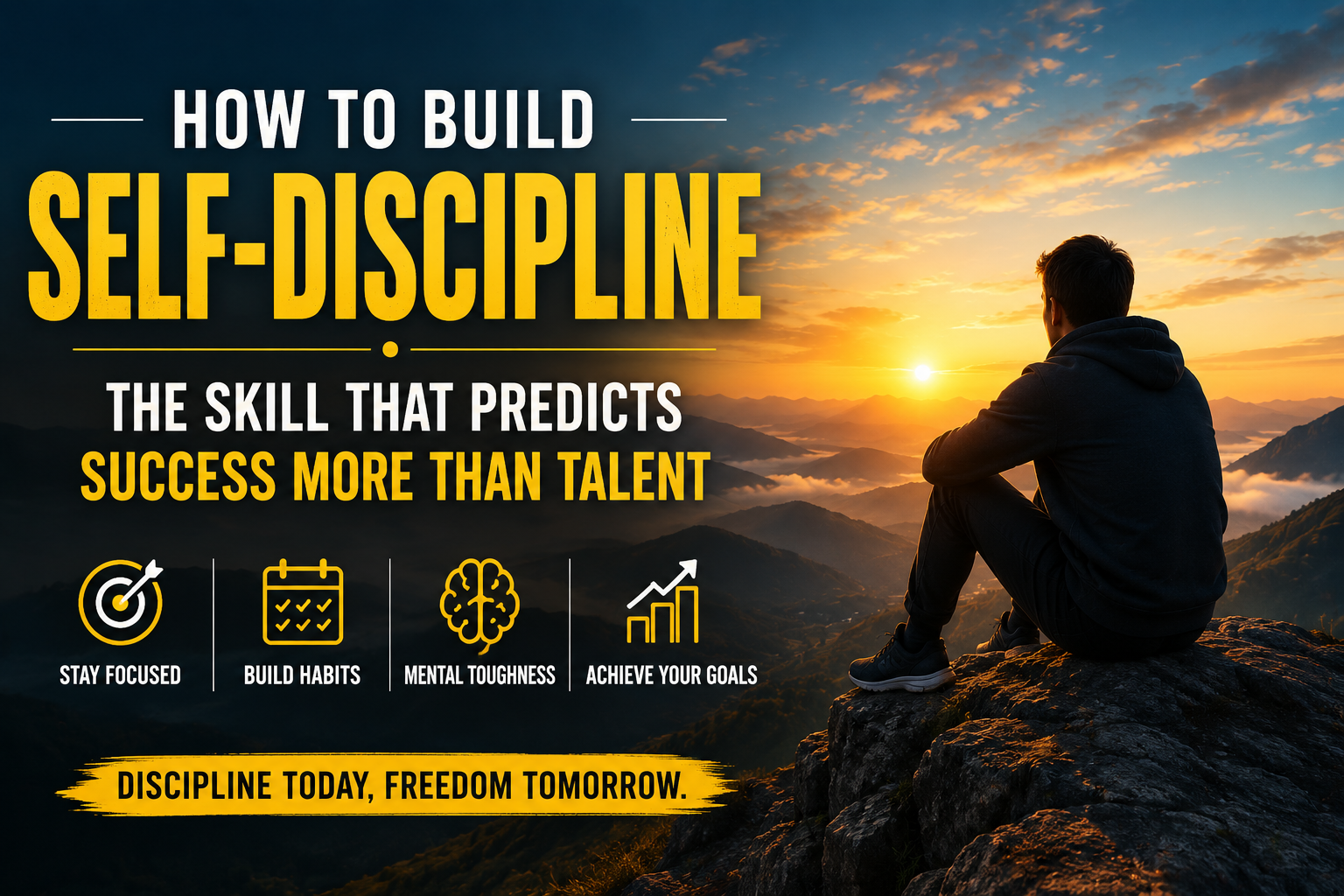
How to Build Self-Discipline: The Skill That Predicts Success More Than Talent
Many people believe success is primarily determined by intelligence, talent, luck, or opportunity.
But when researchers study high achievers across business, sports, education, and personal development, they consistently find another factor that often matters more: self-discipline.
The ability to do what needs to be done—even when you don't feel like doing it—is one of the strongest predictors of long-term success.
If you can master self-discipline, you can build almost any skill, improve your health, grow your career, and create the life you want.
Let's explore how.
What Is Self-Discipline?
Self-discipline is the ability to control your actions, emotions, and behaviors in pursuit of long-term goals.
It means choosing what you want most over what you want now.
Self-discipline is not about becoming strict, robotic, or emotionless.
It is about making decisions that align with your future instead of your temporary feelings.
When you develop self-discipline, you stop depending on motivation and start depending on systems.
Why Self-Discipline Matters More Than Motivation
Motivation feels powerful, but it has one major weakness: it comes and goes.
Some days you feel energized and inspired.
Other days you feel tired, distracted, and unmotivated.
If your success depends on motivation, your progress becomes unpredictable.
Self-discipline changes the equation.
It helps you take action regardless of your mood.
Successful people are not always more motivated than others.
They are often more disciplined than others.
The Science Behind Self-Discipline
Research in psychology has repeatedly shown that delayed gratification is strongly linked to positive life outcomes.
People who can resist short-term temptations are more likely to achieve academic success, maintain healthy habits, and accomplish long-term goals.
The principle is simple:
Small daily choices accumulate into large life results.
Every disciplined action is a vote for the person you want to become.
The Biggest Myth About Discipline
Many people believe disciplined individuals were born that way.
This is false.
Discipline is not a personality trait.
It is a skill.
And like any skill, it can be developed through practice.
Nobody starts with perfect discipline.
People become disciplined by repeatedly doing difficult things until those behaviors become habits.
1. Start Smaller Than You Think
One of the most common reasons people fail is that they try to change too much too quickly.
They create unrealistic goals.
They attempt extreme diets.
They design impossible schedules.
Then they burn out.
Instead, start small.
Read one page.
Exercise for five minutes.
Write for ten minutes.
Build consistency before intensity.
Small wins create momentum.
2. Focus on Systems, Not Goals
Goals tell you where you want to go.
Systems determine whether you get there.
For example:
A goal is to lose weight.
A system is exercising every morning and eating healthy meals.
A goal is to write a book.
A system is writing 500 words daily.
Success is usually the result of strong systems repeated consistently.
3. Remove Temptations
Self-discipline becomes easier when temptations are harder to access.
If your phone distracts you, put it in another room.
If unhealthy food is your weakness, don't keep it in the house.
Environment often influences behavior more than willpower.
Design your surroundings to support your goals.
4. Make Decisions in Advance
Many poor decisions happen in moments of emotion.
The solution is simple.
Decide before the moment arrives.
Plan your workouts.
Prepare your schedule.
Set your priorities.
Create routines.
When decisions are already made, discipline requires less effort.
5. Develop a Strong Morning Routine
Your morning often sets the tone for the entire day.
A productive morning can improve focus, energy, and consistency.
A simple routine might include:
Wake up at the same time
Exercise
Read for 15 minutes
Review goals
Plan priorities
You don't need a perfect routine.
You need a consistent one.
6. Learn to Embrace Discomfort
Growth and comfort rarely exist together.
Every meaningful achievement requires temporary discomfort.
Discipline means learning to act despite inconvenience.
You may not enjoy every workout.
You may not enjoy every study session.
You may not enjoy every challenge.
But every challenge makes you stronger.
7. Track Your Progress
What gets measured gets improved.
Track your habits.
Track your workouts.
Track your reading.
Track your learning.
Tracking creates awareness.
Awareness creates accountability.
Accountability creates results.
8. Build Mental Toughness
Mental toughness is the ability to stay committed when things become difficult.
You build mental toughness by doing difficult things regularly.
Take cold showers.
Finish challenging tasks.
Keep promises to yourself.
Each small act strengthens your confidence and discipline.
9. Stop Waiting for Perfect Conditions
Many people postpone action until everything feels right.
The problem is that perfect conditions rarely arrive.
Start before you're ready.
Progress creates clarity.
Action creates confidence.
Waiting creates regret.
10. Become the Person You Want to Be
The most powerful form of discipline is identity-based discipline.
Instead of saying:
"I want to exercise."
Say:
"I am a person who takes care of my health."
Instead of saying:
"I want to read."
Say:
"I am a lifelong learner."
Your actions become easier when they match your identity.
A Powerful Quote About Discipline
"Discipline is choosing between what you want now and what you want most."
This simple idea captures the essence of self-discipline.
Every day presents choices.
Those choices shape your future.
Final Thoughts
Self-discipline is not a talent.
It is not a gift.
It is not something reserved for a select few.
It is a skill that anyone can develop through consistent action.
You do not need perfect motivation.
You do not need perfect circumstances.
You do not need perfect confidence.
You only need the willingness to take the next disciplined step.
Start small.
Stay consistent.
Trust the process.
Your future is built by the habits you practice today.