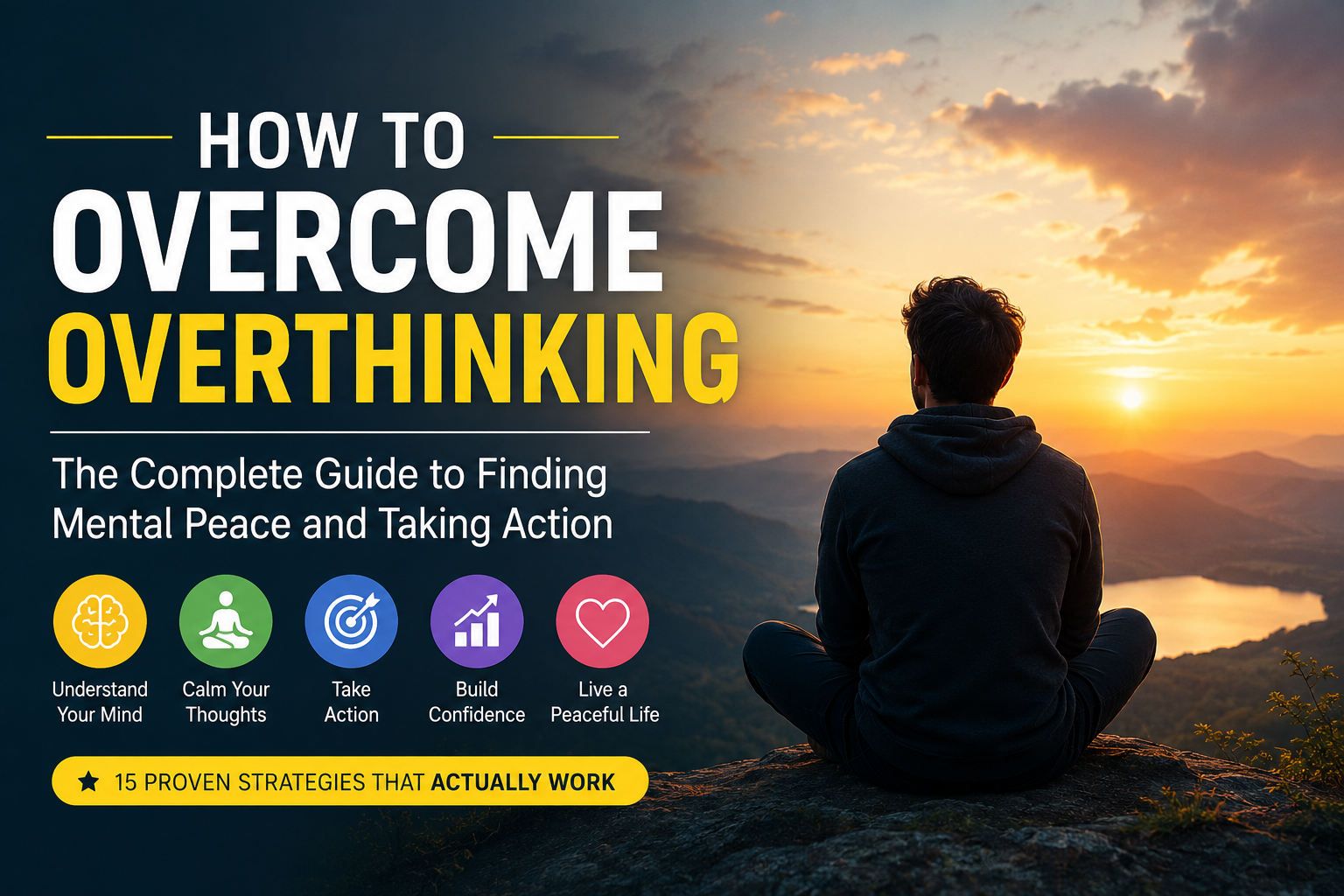
Introduction
Have you ever replayed the same conversation in your head dozens of times?
Have you ever spent hours worrying about something that never actually happened?
Have you ever delayed making a decision because you were trying to find the perfect answer?
If your answer is yes, you are not alone.
Overthinking is one of the most common mental habits in the modern world. While thinking helps us solve problems, overthinking often creates problems that never existed in the first place.
Research published by psychologists has consistently shown that chronic overthinking is associated with higher levels of stress, anxiety, sleep difficulties, and reduced life satisfaction.
The good news is that overthinking is a habit, not a permanent identity.
And habits can be changed.
What Is Overthinking?
Overthinking is the habit of continuously analyzing, worrying, replaying, or imagining situations without reaching productive conclusions.
Instead of helping you move forward, overthinking keeps you mentally stuck.
Common examples include:
Constantly worrying about the future
Replaying past mistakes
Overanalyzing relationships
Fear of making wrong decisions
Imagining worst-case scenarios
Seeking endless reassurance
The mind believes it is solving problems.
In reality, it is often creating emotional exhaustion.
Why Do People Overthink?
Fear of Failure
Many people overthink because they want certainty.
They want guarantees before taking action.
But life rarely offers guarantees.
The search for certainty often becomes the source of endless mental loops.
Fear of Judgment
People frequently ask themselves:
What will others think?
What if I embarrass myself?
What if I fail publicly?
This fear creates mental paralysis.
Perfectionism
Perfectionists often overthink because they believe every decision must be perfect.
But perfection does not exist.
Progress does.
Past Negative Experiences
A painful mistake can teach the brain to become overly cautious.
The mind begins analyzing every possibility in an attempt to avoid future pain.
The Hidden Cost of Overthinking
Most people underestimate how expensive overthinking is.
Overthinking costs:
Time
Energy
Confidence
Creativity
Relationships
Opportunities
While you are thinking endlessly, life continues moving.
Opportunities rarely wait for perfect certainty.
15 Proven Ways to Stop Overthinking
1. Focus on Action, Not Analysis
Action creates clarity.
Analysis rarely creates clarity by itself.
Instead of asking:
"What is the perfect decision?"
Ask:
"What is the next small step?"
2. Set a Thinking Deadline
Give yourself a specific amount of time to think.
For example:
"I will think about this for 20 minutes and then make a decision."
Deadlines prevent mental spirals.
3. Write Your Thoughts Down
Writing helps transfer thoughts from your mind onto paper.
This often reveals that many worries are repetitive and unrealistic.
4. Challenge Worst-Case Scenarios
Ask yourself:
Is this likely?
What evidence supports this fear?
How would I handle it if it happened?
Most fears become less intimidating when examined logically.
5. Stop Trying to Control Everything
Many sources of stress come from attempting to control uncontrollable events.
You cannot control:
Other people's opinions
The future
Unexpected events
You can control your response.
6. Practice Mindfulness
Mindfulness trains attention.
Instead of living in future worries, you learn to experience the present moment.
Even five minutes daily can make a significant difference.
7. Limit Information Overload
Too much information often creates more confusion.
At some point, research becomes procrastination.
8. Accept Imperfection
Perfect decisions do not exist.
Successful people are not people who always choose perfectly.
They are people who adjust when necessary.
9. Take Care of Your Physical Health
Sleep deprivation, poor nutrition, and inactivity often amplify overthinking.
Your brain functions better when your body is healthy.
10. Ask Better Questions
Instead of:
"What if everything goes wrong?"
Ask:
"What if everything works out?"
The brain often follows the direction of your questions.
11. Reduce Social Comparison
Comparing your life to others can trigger endless mental stress.
Remember:
People usually share highlights, not reality.
12. Build Confidence Through Small Wins
Confidence grows from evidence.
Every completed task becomes proof that you can handle challenges.
13. Learn to Tolerate Uncertainty
Uncertainty is not a problem to eliminate.
It is a reality to accept.
The more comfortable you become with uncertainty, the less power overthinking has.
14. Talk to Someone You Trust
Sometimes a conversation provides clarity that hours of thinking cannot.
A fresh perspective can break mental loops.
15. Remember This Powerful Truth
Most of the things you worry about will never happen.
And if they do happen, you are often stronger than you think.
A Simple Daily Exercise to Stop Overthinking
Every night, answer these three questions:
What am I worried about?
Can I control it?
What action can I take tomorrow?
This exercise transforms worry into action.
Final Thoughts
Overthinking is not intelligence.
It is often fear disguised as preparation.
The goal is not to stop thinking.
The goal is to think clearly and then act courageously.
Your future will not be built by perfect thoughts.
It will be built by consistent actions.
You do not need more certainty.
You need more trust in your ability to handle whatever comes next.
The moment you stop trying to control every possibility is the moment you begin experiencing greater peace, confidence, and freedom.